
New Explorers
The IOCs’ success has encouraged independent oil companies to venture farther offshore — prospecting for oil down-dip from discovered gas fields, in deeper water of around 3 km.
Credentialed explorers are racing into the Comoros.
Since the Comoros Republic published its new petroleum law in 2012, new players have included Bahari Resources, Discover Exploration, Western Energy, Tullow Oil and Colossal Energy Fields.
A new era of seismic surveying began in the Comoros, with new 2D seismic data acquired in 2014 that tied to 20,000 line-km of ION’s regional SPAN surveys shot in 2011 across East Africa’s giant discoveries.
The bar was raised further when credentialed explorer Tullow Oil joined the hunt — following successes in Uganda, Ghana and Kenya, and in Guyana and Suriname. Tullow acquired a new 3D seismic survey in 2019 across parts of its Comoros licences.
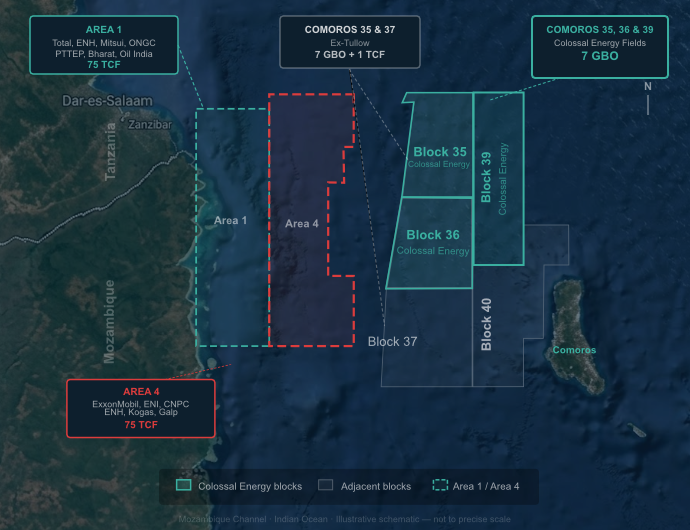
The Comoros oil frontier and adjacent licence holders. Colossal Energy is negotiating Blocks 35, 36 and 39; the ex-Tullow Blocks 35 and 37 sit immediately west, with the prolific Area 1 and Area 4 gas complexes down-dip in the Rovuma Basin. Illustrative schematic — not to precise scale.
This is a massive frontier opportunity at all scales — the turbidite systems, the leads we’ve mapped. We’ve evaluated many licences up and down East Africa; this one passed our selection criteria. We believe there’s an oil kitchen out here, outboard of the gas.
Gross mean unrisked prospective resources, Blocks 35–37
Colossal Energy — Blocks 35, 36 & 39
Area 1 — adjacent gas in place
Area 4 — adjacent gas in place
This premier 3D survey in the Comoros was the first since ION’s pioneering regional SPAN surveys in 2011 and the 2014 infill. Two partly stacked prospects in Comoros Blocks 35, 36 and 37 together contain gross mean unrisked prospective resources of about 7.1 billion barrels of oil, according to an August 2018 Competent Persons Report by ERCE, a UK-based independent energy consulting group. These built upon earlier 1980s-vintage seismic reflection and refraction studies conducted aboard the research vessels R/V Vema and Conrad of Columbia University’s Lamont-Doherty Geological Observatory.